Tuesday, April 14, 2009

Who Says You Can't Grow a Garden without “Crop Protection Products”?

Organic gardening on the White House lawn? Plants grown without artificial fertilizer and insecticides? Children learning that food comes from the soil and not from the supermarket?

The Mid America CropLife Association just won't stand for it any longer. Appalled by the revolution sprouting where manicured, fertilized, and properly “crop protected” lawn used to sit, this agricultural trade association has decided to educate Michelle Obama and her young associates about the proper role of a garden.

Not only did Executive Director and Program Director of MACA send a letter to Mrs. Obama, they also forwarded it to their associates with the warning:
While a garden is a great idea, the thought of it being organic made Janet Braun, CropLife Ambassador Coordinator and I shudder. As a result, we sent a letter encouraging them to consider using crop protection products and to recognize the importance of agriculture to the entire U.S. economy.

Of course! Plant one organic garden outside the White House, and then everybody will have a garden in their backyard, and sooner than you can say “organically grown,” the fragile edifice that is American agribusiness will come crumbling down in a torrent of corn husks.

The letter goes on to extol the virtues of American agriculture, claiming that “many people, especially children, don't realize the extent to which their daily lives depend on America's agricultural industry.” Okay, and having kids create a garden won't enlighten them about where their food comes from?

No, starting a garden is not worth the effort the letter-writers warn. “The time needed to tend a garden is not there for the majority of our citizens, certainly not a garden of sufficient productivity to supply much of a family's year-round food needs.”

Furthermore, the writers claim that “much of the food considered not wholesome or tasty is the result of how it is stored or prepared rather than how it is grown. Fresh foods grown conventionally are wholesome and flavorful yet more economical” than food grown using “organic” methods, a word these writers don't even want to mention.

These CropLife Ambassadors then generously offer to “educate” Mrs. Obama and her young gardeners. "The CropLife Ambassador Network offers educational programs for elementary school educators at http://ambassador.maca.org covering the science behind crop protection products and their contribution to sustainable agriculture. You may find our programs America's Abundance, Farmers Stewards of the Land and War of the Weeds of particular interest."

This kind of propaganda would be merely amusing (I really, really want to see the War of the Weeds), but it does show just how scared big agribusiness is of Americans caring about and wanting to learn about how their food is grown and what effect our conventional methods of agriculture are having on the environment, on fuel consumption, and on our national security (as the price of food rises around the world so does political instability).

While the CropLife Ambassador Networks wants Americans to imagine a bucolic world of abundance, where an acre of land yields “42,000 lbs. of strawberries, 110,000 heads of lettuce, 25,400 lbs. of potatoes, 8,900 lbs. of sweet corn, or 640 lbs of cotton lint,” the real focus of agribusiness is directed towards the production of corn, meat and dairy products, and soybeans.

The Food and Agriculture Organization of the United Nations reported that as of 2003 the top five U.S. agricultural “products” were: 1. Corn 256,904,992 2. Cattle meat 11,736,300 3. Cow's milk, whole, fresh 78,155,000 4. Chicken meat 15,006,000 5. Soybeans 65,795,300 (all in metric tonnes).

Add to that the fact that more than 50% of the corn grown in the U.S. is fed to animals and that an increasing percentage is going towards ethanol production, and you can see that providing your local family with lettuce, strawberries, and sweet corn ranks way down the list of agribusiness priorities. Throw in the additional fact that more than 50% of antibiotics used in the U.S. go to animals raised for food, and you can see that “crop-protection” products may well protect “crops” (plant and animal) at the expense of those who consume them (Mark Bittman, Food Matters, p. 23).

To add insult to injury, the Mid America CropLife Association is affiliated with CropLife America, a marketing association funded by the Department of Agriculture, that is, taxpayers like you and me. A list of the member organizations of Mid America CropLife reads like a who's who of the chemical industry, including, but not limited to: Aceto Agricultural Chemicals Corporation, Cheminova Inc., Dow Agrosciences, Kova Fertilizer, Monsanto, and United Phosphorus, Inc.

No wonder they shudder at the thought of the White House putting its imprimatur on an organic garden and teaching kids that they can grow food without pesticides.

After all, that's how we got people to stop smoking: by showing them just what kind of chemicals they were ingesting with every puff and educating the young, who in turn, educated their parents.

So even if you laugh at the Mid American CropLife Association's overreaction to Mrs. Obama's organic garden, don't fail to take them seriously. And while you're at it, send Mrs. Obama and her gardeners a letter of thanks for making a garden grow in a way that benefits the earth and all of us.

Saturday, April 11, 2009

An Immigrant Story: Retracing my Family's Journey to America

Photo of Steinbach-Hallenberg by Stefan Nothnagel (24.12.2006)

From Beth Wahl Family Small
Photo of my Paternal Grandfather Adolph Wahl (January 7, 1886-November 30, 1930)

A few years before he died in 1978 my father sat down and typed up all he could remember of his family history. This is how his story begins:
In west central Germany in the general vicinity of Erfurt is a small town named Steinbach-Hallenberg which is approximately twenty miles south of Eisenach, Thüringer. So far as is known its only industry was a nail factory, which provided the principal income for the townspeople. Near the end of the nineteenth century, all that I know of my father's family left there and emigrated to America. The family consisted of my grandmother Mary Wahl and her three sons Adolph, August, and David. My father was about seven years old when they landed at Ellis Island and settle din the metropolitan New York-New Jersey area. My uncle August became a toolmaker, Adolph and electroplater, and David a house painter...David was the eldest and lived his whole life in Newark, New Jersey. My father, Adolph, was very energetic and ambitious. I recall he rode a motorcycle from Newark to Rochester, New York in 1910. August never married and lived most of his life in New York City until he passed away in 1960.

My father's autobiography begins, not with his own birth, but with the exodus of his ancestors from their homeland, constructing a narrative that echoes the structure of a fairy tale: a widowed mother with three boys, leaving their small town to seek their fortunate in a strange new land.

I was fifteen when my father died, and I hadn't yet developed a curiosity about my family origins. If anything, I was relatively prejudiced against all things German, which I associated with older relatives pontificating about the past and too much wurst, potatoes, and long drawn-out family gatherings.

But this summer I will finally make my father's father's journey in reverse, traveling from America to Germany, and for the first time in two generations, I will meet some of the Wahls who did stay behind in Steinbach-Hallenberg.

Now I want to ask him so many questions: Who told you the family came from Steinbach-Hallenberg? Did the nail factory shut down? What made your paternal grandmother decide to leave and what happened to her in America? Why did August never marry, and why did your father leave the family in Newark to make a new life for himself in the upstate town of Rochester so far away and so different from Newark or Manhattan?

In the meantime, I am trying my best to piece together some of the history that lies behind those all too brief sentences my father typed out for his children in the basement of our house in Detroit.

Some of the things I've found out have been surprising. Searching the Ellis Island archives, I discovered that David Wahl traveled three years before his mother and younger brothers on the ship Lahn arriving on June 8th, 1893 when he was only 16 years old. Marie Wahl arrived July 2, 1896 on the same ship with August and Wilhelm Adoph, my paternal grandfather. I've also discovered that Marie Wahl's maiden name was Bauerschmidt and that her husband, Peter Wilhelm Wahl died in 1893, a scant six months after his eldest son, David, arrived in the United States.

Travelling to Ellis Island two summers ago, I had a chance to see just a little bit of what my grandfather and his brothers might have experienced in 1896 when they arrived on the Lahn. If they had first or second-class tickets, the immigration experience would have been not much more burdensome than what we experience today in customs: a cursory inspection aboard ship.

However, if they were third class or “steerage” passengers they would have traveled in crowded, and not very sanitary conditions near the bottom of their steamship, spending perhaps two weeks in their bunks before they finally could breathe fresh air. Upon arrival in New York City, the ships would dock at the Hudson or East River piers and allow the first and second class passengers to disembark first. The other passengers were taken from the pier by ferry or barge to Ellis Island where everyone had to undergo a medical and legal inspection before being released. Most likely David had encountered a friend or family member to meet him at Ellis Island, but I cannot know this for sure.

All I can say is that standing on Ellis Island on a humid morning in July with the air so thick and cloudy it felt that you could cut it with a knife, I imagine that it would have been both thrilling to see the Statue of Liberty so close at hand and a little frightening as well to realize that only a narrow channel of water separated you from unforeseen adventures in Manhattan or on the Jersey shore.

Still as I reread my father's words, so many questions run through my mind: Why did David go ahead of the others? Did Marie and her children wait to follow David because their father was ill? Was the original plan for all of them to emigrate together? Why did Marie wait almost three years to follow her sixteen-year-old son? And what did he do for those three years while he waited for the rest of the family to arrive?

I am so grateful to have the story my father left me and to have been able to discover a few more facts with the help of archives and my cousins in the U.S. who share my interest in family history. Now that I have the chance to reconnect with my German cousins in Steinbach-Hallenberg, I may even be able to answer some of those questions that remain.

This is most definitely an episode “to be continued.”

Thursday, April 9, 2009

Putting the Screws on Credit Card Debtors

Today Bank of America joined a number of other credit card issuers in raising credit rates for borrowers who carry a balance. These are not credit card holders who have failed to pay on time, or who have any history of credit problems. Many of them even pay more than the minimum balance each month.

But they do have the misfortune of carrying a balance on their credit cards, putting them among the more than 50% of families who don't or can't pay off their credit card balances each month.

The average balance per open credit card -- including both retail and bank cards -- was $1,157 at the end of 2008. That's up from $1,033 at the end of 2006, a growth of nearly 11 percent in two years. (Source: Experian marketing insight snapshot, March 2009).

Even though credit card borrowing fell in February 2009, the number of credit card holders defaulting on their debt has continued to rise in the very same month. According to Reuters, “U.S. credit card defaults rose in February to their highest level in at least 20 years, with losses particularly severe at American Express Co (AXP.N) and Citigroup (C.N).” Incidentally American Express is the company that recently gained notoreity by paying low-charging customers to close their accounts, and Citigroup has been one of the most aggressive in raising rates.

Recently Congress has considered legislation to stop some of the credit card companies' practices that hurt consumers most:

Suddenly raising interest on accumulated balances
Raising rates across all credit cards held by a borrower because of a late payment made on one card
Charging for payments made over the internet or phone


The bad news for consumers is that these changes will not take place until 2010, and in the meantime, credit card companies are doing everything possible to wring out what they can in fees and interest rate increases while they still can.

To be fair, credit card companies are facing their own limitations on how much they can lend in a financial system where banks are leery even of lending to one another. Since the recession has dragged on, and unemployment has escalated, credit card companies have little way of knowing which of today's “good” customers may be tomorrow's defaulting customers because of escalating job losses. As a result, “Meredith Whitney, one of Wall Street's best known and most bearish bank analysts, estimates that Americans' credit card lines will be cut by $2.7 trillion, or 50 percent, by the end of 2010 -- and fewer Americans will be offered new cards.”

Some of those who pay off their balances every month and enjoy good credit may feel scant sympathy for those who are facing higher rates because they still carry credit card balances. But it's hardly a secure position when even good borrowers are losing their home equity lines and finding other sources of credit drying up.

If credit card companies continue to squeeze those who are paying them on a regular basis, particularly by lowering their credit limits and injuring their creditworthiness, they risk worsening the already weak consumer spending that generates a substantial portion of the United States' gross domestic product (GDP).

What looks like fiscal prudence now could also backfire on credit card companies when the economy begins to rebound, as many consumers may choose to get rid of their cards rather than pay the higher fees and interest rates.

For example, “Tamara Smith of Burlington, Vt., got a notice from Bank of America that her 7.9% rate will increase to nearly 13%. She immediately called the bank and opted out of the change. That means she keeps the 7.9% rate on her roughly $2,000 balance, but can't use the card for new purchases without having the higher rate apply to her entire balance,” (“BofA to Boost Rates on Cards with Balances,” The Wall Street Journal, April 9, 2009).

Credit card companies may find a short-term profit boost in these actions, but as more consumers move from credit to debit cards or even to cash, they may find little reason to return to the companies that tried to ditch or gouge them. And credit card companies may find it much harder to woo back the American consumer in good times when they have treated the consumer so badly when times were bad.

Wednesday, April 1, 2009

If It's on the Internet, It must be True

A couple of days ago, my nine-year-old arrived home from school full of excitement. “There's this website I have to show you, mom,” he cried.

Mentally I groaned, thinking I was going to have to see some obscure piece of Lego weaponry or yet another video of exploding Coke and Mentos. “Okay,” I replied reluctantly. “You have to go to www.allaboutexplorers.com, and click on Christopher Columbus,” he continued. Once there I found the following:
Christopher Columbus was born in 1951 in Sydney, Australia. His home was on the sea and Christopher longed to become an explorer and sailor. However, as a young man, Christopher went to Portugal and got involved in the map making business with his brother, Bartholomew. This business made Columbus a rich man. His books of maps are still found today in every library in the world.

I started laughing and Nico joined in, unable to contain himself at the joke. “There was a teacher who read this to her class, and only one kid, one kid in the whole school realized it couldn't be true, Mom,” he said proudly.

“Well,” I told him, “you know how I always tell you: 'If it's on the Internet, it must be true'.” "I'm really glad your librarian showed this to you,” I added. “The Internet is a great resource but you have to be sure that any website you use is a reliable one.”

I kept thinking about this example of a teacher getting kids to think about sources they find on the web, and it made me realize that the Internet has simply writ large a problem that has always existed.

While I sympathize to some degree with teachers who don't want kids just to go to Wikipedia to do all their research and forget how to use a book, I also don't agree with those teachers who simply ban the use of Wikipedia altogether.

With all its flaws, Wikipedia is a monument, not just to collective knowledge, but to the collective regulation of knowledge, that has not been equaled since Diderot and his fellow philosophes conceived of the Encyclopedie. With its constant updating and editorial self-review, the Wikipedia is probably the most peer-reviewed resource on the planet, and one with the capacity to add new sources of knowledge at a rate faster than any other published source.

Rather than telling kids not to use this resource, Wikipedia offers a great place to begin discussing why some sources are more reliable than others and why good research has to go beyond any encyclopedia to be sufficiently extensive.

Beyond Wikipedia, the Internet offers phenomenal resources for research as many libraries continue to put primary sources online, some in facsimile formats, that allow students to get to information that otherwise would require extensive preparation and the expense of travel. For elementary and middle school kids, the most important part of using the Internet is having teachers set up the right kind of portal with pre-selected websites, while high school students can be given tools to help them evaluate the reliability of a website on their own.

At the same time, for those who bemoan that Internet research is replacing a trip to the local library, it's a good idea to remember that just because something is published in a book is no guarantee that it's necessarily the truth.

Michael Bellesiles' Arming America: The Origins of a National Gun Culture won the prestigious Bancroft Prize in History before subsequent scholars began re-examining the validity of his research and thus questioning the basis for this arguments. As a 2002 Emory University Report of the Investigative Committee in the matter of Professor Michael Bellesile finally put it: “[T]he best that can be said of his work with the [historical] record is that he is guilty of unprofessional and misleading work. Every aspect of his work in the probate records is deeply flawed.”

How many students used this highly praised book published by the respected Columbia University Press for their research before it was shown to be “deeply flawed” is anyone's guess. But it does demonstrate that the old adage, “don't judge a book by its cover” should be extended to cover the awards on its jacket and the blurbs on the back.

In fact, some of the most interesting research that I've done myself has stemmed from uncovering primary sources that have been obscured, falsified, or marked as “unreadable” by a book that cites them. For example, Lilian Faderman in her famous work on “romantic friendship” between women in the 18th and 19th century argued that no one ever suspected such friendships to be “lesbian” in character because sexual relations between women were unimaginable at the time.

But much of what Faderman came across as “sources” were works that had been “cleaned up” or even censored by Victorian editors. Her most famous example was a celebrity couple, the Ladies of Llangollen, who ran away as teenagers and spent the rest of their adult lives living together. Their “friendship” was widely idealized at the time, and they received visits from many famous politicans and writers in their day who never publicly stated that there was anything untoward in their domestic arrangements. But in their diaries, the comments could be much less polite. Hester Thrale Piozzi wrote in the manuscript version of her diary that the ladies were in fact “damned sapphists,” a contemporary term for “lesbian,” and a reference that was deliberately left out when her diaries were published years later.

The point is that whether a source exists in cyberspace or on the shelves of the local library or bookstore, we should never take the information we find for granted. Whenever possible, we need to educate our children to seek out the primary sources that others use to build a narrative about an historical event, or a set of medical data, or a social phenomenon like women joining the work force. What they find there may reinforce or it may undermine the narrative they've been reading, but the more they understand the relation between primary sources and the secondary source that builds on them, the better they will be at evaluating the books and web sites they use and thinking about them critically.

Which brings me full circle to my son and his “not really all about explorers” website. “How did you know that the information on Christopher Columbus was false?” I asked him. First he rolled his eyes at me. Then he said, “Well if Columbus sailed in 1492, he couldn't have been born in 1951, could he? He'd, like, have to be 500 years old!”

“Exactly,” I replied. A little arithmetic and some common sense goes a long way when you're researching. A little skepticism doesn't hurt either.

And you've read this on the Internet, so it must be true.

Monday, March 30, 2009

Want to Cut Your Carbon Footprint? Change the Way You Eat

Most of us probably already know the basic changes we can make in our lifestyles to reduce our impact on the planet's resources and cut our contribution to greenhouse gas emissions. We can recycle, replace our traditional incandescent light bulbs with CFL (compact flourescent light) bulbs, and bike or walk instead of taking the car whenever possible.

But another way we can have a significant impact on our carbon footprint is one we easily overlook: we simply change the way we eat.

Mark Bittman's Food Matters is not just another best-selling “green” consciousness-raising tome. Instead, it presents a simple idea in clear engaging prose that only takes up a little less than half the book. The rest is full of shopping lists, meal plans, and recipes to make it easy for the reader to put the ideas into action. Since Mark Bittman is also a renowned chef and general “foodie,” this section of the food is well worth looking into.

Bittman doesn't argue that you must eat organic or become a vegetarian or only buy locally grown food. His approach is not at all dictatorial. Any change you make towards eating more “whole” foods (an apple, not little tins of applesauce, peanuts rather than a Snickers bar, potatoes rather than chips) anything rather than processed foods will be good for your health, easier on your wallet, and better for the planet.

Food Matters singles out one important destructive dietary trend. As more and more countries, including China, adopt the Western diet with its emphasis on red meat and refined carbohydrates, the world will no longer be able to sustain current practices for raising animals for food (for example, global meat consumption is expected to double in the next forty years).

Factory farms already raise 60 billion of these animals every year in conditions that would have been unthinkable a century ago, but if demand keeps growing at current rates, we will need to raise 120 billion animals a year by 2050, and we will run out of the agriculture land necessary to raise the feed for all these cows, pigs, sheep, and poultry.

It's not just that a heavily meat-based diet is unsustainable, but as Bittman points out, it is also highly consumptive of fossil fuels. “To produce one calorie of corn takes 2.2 calories of fossil fuel. For beef the number is 40: it requires 40 calories to produce one calorie of beef protein,” (26).

Statistics from the Energy Information Administration of the Department of Energy suggest that the average American burns about 530 gallons of gas by driving and about 400 gallons of fossil fuels if that same American consumes an average American meat-based diet.

As Bittman puts it, “If we each at the equivalent of three fewer cheeseburgers a week, we'd cancel out the effects of all the SUVs in the country,” (17).

And raising the meat we love to eat doesn't just consume a whole lot of fossil fuels, it also contributes to the rapid deforestation of the third world as rainforest is burned in Brazil to make way for cattle ranching and sugar production for ethanol, and Malyasia and Indonesia see the destruction of their forests to foster the production of palm oil, another common ingredient in processed food.

To make matters worse, the methane produced by cattle is also a significant part of agricultural greenhouse gas emissions and the huge amounts of manure threaten both water and air quality in many parts of rural America.

Bittman's second nightmare food ingredient also leads back to the production of corn but this time in the form of high fructose corn syrup (HFCS). Most Americans consume HFCS in the form of carbonated soft drinks like Coke, Pepsi, 7-Up and Sprite; as an aside Bittman notes that as a nation we actually consume 7% of our daily calories from soda. Not only does the consumption of sugar in this form tend to generate a greater craving for more and more sugar, but it's believed to be a leading contributor to the rise in Type 2 diabetes, especially among the young.

Now I'm going to follow Bittman's lead in not dictating any particular way of eating. But I do recommend a trip to the library or bookstore to check out Food Matters.

And I will ask my readers: Please consider giving up meat one or two days a week. Or if this is too much, keep the HFCS out of your grocery basket. An apple on your desk, a packet of trail mix in your purse, a refillable water bottle in your car will all go a long way towards keeping you and our planet healthy.

Bon appetit!


Sunday, March 29, 2009

Dreaming of Patagonia

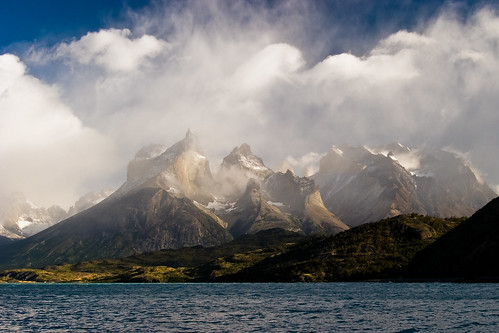
Cuernos del Paine (Feb. 2008)
with permission, Andres Diaz, Cuernos del Paine, February 2008

I remember vividly when my boyfriend first told me he was “going to take me to the most beautiful place in the world.” At the time, I thought that he was either a hopeless romantic or that he was practicing some great pick-up lines.

A mere six months after our wedding I found myself mentally eating those badly chosen words as I emerged from a dirt road surrounded on both sides by patches of dusty raspberry bushes and dense green foliage to one of the most beautiful vistas I've ever seen, yellow-green fields rolling down to a intensely blue lake with a snow-capped volcano on the opposite shore.

From Vacation Chile 2003-2004


It was my first trip to Chile, and I had to agree with my husband, we had arrived at the most beautiful place I'd ever seen.

However, there was a downside to this discovery of a Latin American Shangri-La. Since my husband's family owns property on the shores of this lake with the incredible view of Volcan Villarrica, I rarely get to go anywhere else when we travel there.

My husband, who has over one million miles of airtime with American Airlines and nearly the same with United, doesn't want to travel when he goes on vacation. He wants to arrive at the most beautiful place in the world and stay there.

I, however, suffer from wanderlust. Since we married in 1987 I have seen the capital of Chile (Santiago), the seaside city of Viña del Mar, the family fundo (farm) on the banks of Lago Villarrica, and not a whole lot else, apart from some sides trip in the lakes region to Frutillar, a German-style village on the shores of Lake Osorno, the exquisite emerald green Lago Todos los Santos, and the port city of Puerto Montt.

But in the back of my mind there has been one part of Chile that holds a kind of magical appeal for me: Patagonia.

Chile is full of places named in the language of the native Mapuche people that roll off the tongue and make you want to see the location that gave rise to such linguistic invention. My favorite is the little town of Panguipulli, which is pronounced “pan-gi (hard “g”)-pu-yee), and means hill of the lion or puma. Set on the shores of Lake Panguipulli, you can see that the residents have a sense of humor about their town's name – the local panaderia sells “Pangui-pan.”

From Vacation Chile 2003-2004


So it's no wonder that Patagonia has held a special appeal for me, one that I felt even before I met my husband and was immersed in Chilean culture. Patagonia is a kind of utopia, a “no-where” land, a place so large and sparsely inhabited that one of the largest volcanic eruptions occurred in the far north of Patagonia in August 1991, and almost no one noticed.

According to the venerable Oxford English Dictionary, there are at least three viable speculations about where the word Patagonia comes from. One of them argues that it derives from the Spanish word patagon meaning “a large clumsy foot,” since the Spaniard Magellan thus named the deep footprints of natives dancing in the sand when he first stopped on the southernmost shores of South America.

A second and more unlikely theory links “Patagonia” to the Incan word, Patac-Hunia, for “mountain regions.”

The third explanation, and my favorite, again links Magellan to the origins of the word but this time attributes it to Magellan's description of some of the natives who were wearing “dog-faced” masks. A popular novel of Magellan's time, Primaleon of Greece, featured a dog-faced monster named Patagon. This was the same text that gave rise to Shakespeare's equation of the native character Caliban with a “puppy-headed monster” in his play The Tempest.

Dick Lutz, author of Patagonia: At the Bottom on the World, points out that Patagonia is referenced with surprising frequency in Western literature, appearing in works by Shakespeare, Lord Byron, Jules Verne, Herman Melville, Sir Conan Doyle, Edgard Allen Poe, and of course, Coleridge's famous poem, “The Ancient Mariner.”

So for me, as a student of literature, and as one long fascinated by the name and the idea of Patagonia, the land at the end of the earth, there could not be a more felicitous intersection of circumstances. In 2010 I am determined that my sojourn in Chile will not be bounded by the shores of Villarrica, however lovely they may be, and I will keep my readers apprised of all that I learn as I read more about and continue to dream of wandering through wilds of Patagonia.

Monday, March 23, 2009

Newspapers: An Endangered Species or an Evolving One?

In the past few weeks, two major dailies ceased to exist in print form. One was The Rocky Mountain News and the other The Seattle Post Intelligencer. The loss of these papers leaves their hometowns with only a single paper to cover local issues. Many other major cities like San Francisco and Detroit, are already in this position, and more cities are likely to join them as local and regional newspapers find it increasingly hard to compete in the world of the 24-hour news cycle and the instant access to breaking news that the Internet provides.

Many fear that the quality of local reporting will suffer as a result, and that the public will find it harder to hold their local officials accountable because they won't really know what is going on in their schools or mayors' offices.
Yet the power of print has faced such doomsaying before and survived, even thrived. Books have not yet been replaced by movies, CDs, videogames, TV, or the Internet, and there are in fact more literate people on the planet in 2009 than at any time in history.

So the market for news is there and growing: the difficulty is how to make room for the news you get on your iPhone and the pleasure of sitting at your local cafe and leafing through pages of newsprint you can hold in your hands.

And more importantly, since newspapers are a business and not a public service, how can they continue to generate enough revenue to survive when so many of us think that just about any content we get off the Internet, we should get for free.

If you take my hometown, Palo Alto, you could say that the newspaper business is thriving. We not only have The Palo Alto Daily News available online and in a paper version, but in the ten years I've lived here, that little paper has been joined by The Daily Post and other variations on the same theme for other local cities. These papers, although a little tabloid-like for my own personal taste, do take on city hall, the local school board, utilities, cable companies. You name the muck; they rake it.

On the other hand, the two major cities I live closest to – San Francisco and San Jose-- have seen their daily newspapers shrivel to a mere shell of their former selves. As Gertrude Stein once said of Oakland, “there's no there there” any more. And both of these papers, The San Francisco Chronicle and The San Jose Mercury News, seem to be caught in a vicious cycle of shrinking ad revenue, shrinking staffs, shrinking content, shrinking readership.

Newspapers need a new business model, and they might find one in the world of non-profits like National Public Radio and the Corporation for Public Broadcasting where your target audience subscribes to content that is ostensibly “free” but at the cost of a nominal membership fee, corporate underwriting, and government subsidy. Surely, if the U.S. government can underwrite the transition to digital TV, it can shell out a little money to keep a free press alive.

A more promising approach is the idea of bundling news content in the same way that database companies have cooperated to provide a whole range of print journals online to public and university libraries. If a user knew that s/he could get the sports page from The Chicago Sun-Times, the editorial page from The New York Times, politics fromThe Washington Post, business reporting from The Wall Street Journal, and local news from their local newspaper, s/he might be willing to ante up for the privilege of getting that information online.

If newspapers were willing to allow users to select a slice of their content and create their own “personal” ideal newspaper, they might find the audience and the advertisers they are looking for.

In any case, newspapers need to think creatively about how to reinvent themselves before they truly become an “endangered” species, and that would leave all of us much poor for the loss.

For other thoughtful commentaries on the possible demise of the newspaper see The New Yorker, and Clay Shirky's "Newspapers and Thinking the Unthinkable."